
Web App vs Website: Why the Difference Matters More Than Most Business Owners Realise
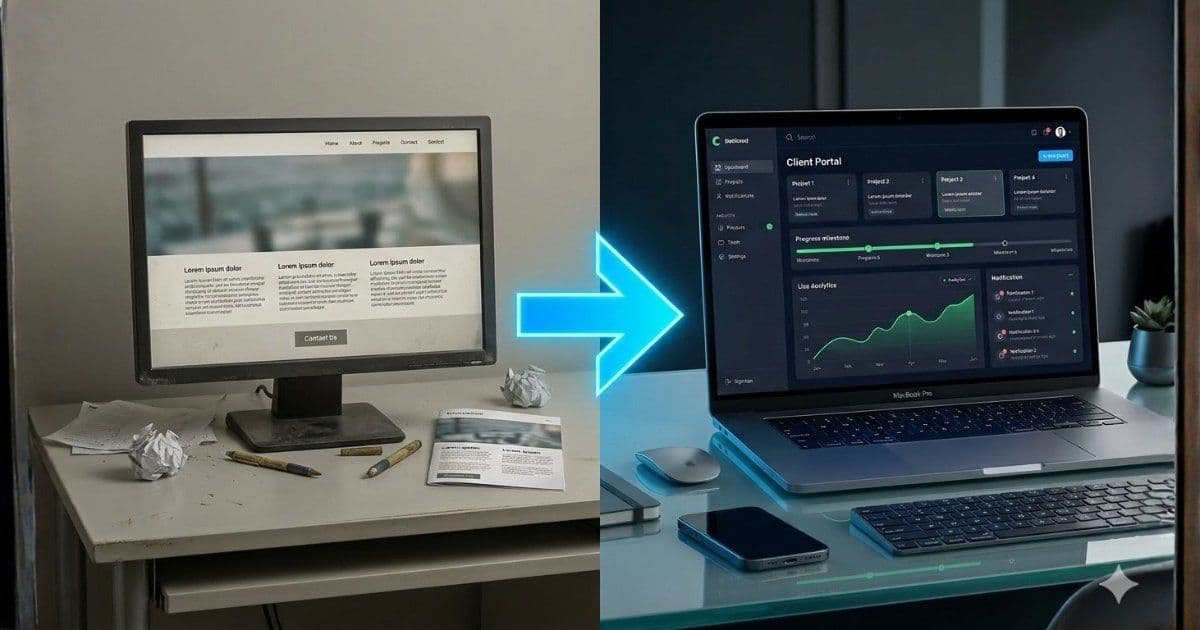
Most businesses reach a point where their digital presence stops scaling with them. They have a website — perhaps a good one — but the real work still happens in email threads, WhatsApp groups, and spreadsheets that live on someone's laptop. Client updates are sent manually. Invoices are tracked in a folder. Project status is a conversation, not a dashboard.
This is not a communication problem. It is an infrastructure problem. And the solution is the shift from a website — a digital brochure — to a web application: a system that runs your operations, serves your clients, and works for your business around the clock.
Whether you are running a professional services firm in Accra, a creative agency in London, or a logistics business in Nairobi, the dynamic is identical. The distinction between a website and a web application is one of the most strategically important technology decisions a growing business makes — and most businesses make it by accident rather than intention.
The Fundamental Difference, Without the Jargon
A website is a one-way information channel. It tells visitors who you are, what you do, and how to contact you. Every visitor sees essentially the same content. It is a digital brochure — useful, but passive.
A web application is an interactive system. It responds to each user individually, processes data in real time, manages workflows, and delivers personalised experiences. A client portal where customers track their projects and pay invoices. A booking system that manages appointments without human intervention. A staff dashboard that shows live project status. An automated billing system tied to your project milestones. These are not features — they are operational infrastructure.
The business that has a web application is running a system. The business that only has a website is still running on manual processes with a digital front door.
What the Data Shows
- Progressive Web Apps (PWAs) increase conversion rates by an average of 36% compared to traditional websites, according to Google's PWA case studies.
- Businesses using web applications report measurably higher user engagement and retention than those relying on static information sites, according to Forrester Research on digital experience.
- Customer retention is significantly higher on platforms that deliver personalised, app-like experiences, according to Adobe's Digital Trends research.
- Page load time improvements that modern web application architecture delivers reduce bounce rates by up to 53%, per Google's Web Performance research.
- Investment in a well-scoped custom web application typically delivers strong ROI over a 3-year horizon — particularly when it replaces manual processes that carry hidden labour costs.
The numbers matter, but the more important insight is this: the businesses we work with that have built client-facing web applications consistently report that the operational savings alone — in staff time, reduced errors, and eliminated manual follow-up — justify the investment within the first year.
What the World's Most Respected Technology Minds Say
"Software is eating the world." — Marc Andreessen, co-founder of Netscape. He wrote this in 2011. Every industry that has since been disrupted was disrupted by software — not by a better product or lower prices, but by a better system.
"Design is not just what it looks like and feels like. Design is how it works." — Steve Jobs, co-founder of Apple. The businesses winning in their markets are not just communicating better — they are operating better. That is what web applications enable.
"The web is the platform." — Tim O'Reilly, founder of O'Reilly Media. The browser is now the universal delivery mechanism for business-critical software. There is no simpler distribution model.
5 Advantages That Directly Impact Business Performance
- Client self-service: Your clients can log in, check their project status, view invoices, approve work, and make payments — without a single phone call or WhatsApp message to your team. The time this saves, compounded across every client, is substantial.
- Real-time personalisation: A web app serves each user exactly what is relevant to them — their projects, their data, their history. Not generic information. This creates significantly stronger engagement than any static website.
- Automated business logic: Milestone billing, payment reminders, status updates, document generation — processes that currently require human initiation can be triggered automatically by system events.
- Cross-platform reach without the cost: A well-built web application works on every device without requiring separate iOS and Android app development. Your clients get a consistent experience whether they are on a laptop in Accra or a phone in Kumasi.
- Scalable infrastructure: Adding ten new clients to a web application costs nothing extra. Adding ten new clients to a manually-managed system costs proportional staff time. One scales; the other does not.
When Do You Actually Need a Web Application?
Be honest about this assessment. A website is sufficient if your digital presence is primarily informational — if you are a new business establishing basic credibility online, or if your customer interactions happen entirely offline.
You need a web application when:
- You manage ongoing client relationships and projects that require regular status updates
- You send invoices, manage payments, or need clients to approve deliverables
- You want to reduce the volume of repetitive enquiries your team handles manually
- You are building any kind of recurring service, subscription, or membership model
- You need your clients or staff to access real-time information from anywhere
- You are losing deals because your operational capability looks less professional than competitors
The Real Cost of Staying Static
The cost of not having a web application is invisible — which is why so many businesses tolerate it for too long. It shows up as staff hours spent on manual updates. As client frustration with slow responses. As deals you almost won but lost on professionalism. As a ceiling on how many clients you can manage without proportionally growing your headcount.
Every day a competitor runs a client portal and you run a WhatsApp thread, the operational gap widens. The good news: it is a solvable problem, and the solution is more accessible than most business owners assume.
If you are ready to see what a web application built around your specific business processes would look like, talk to our team. We will show you a scoped solution — not a generic demo — before you commit to anything.